0
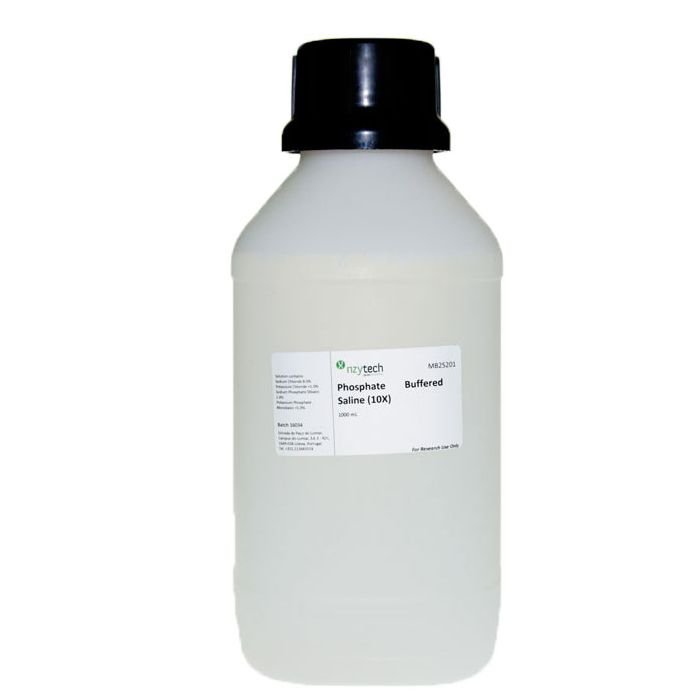
Phosphate Buffered Saline (10X) | Unit Size 1000 mL
£90.00
Pound sterling (£) - GBP
Solution contains:
-Sodium Chloride 8.0%
-Potassium Chloride <1.0%
-Sodium Phosphate Dibasic 1.4%
-Potassium Phosphate Monobasic <1.0%
Description
Phosphate Buffered Saline (PBS): Uses, Preparation, and Key Properties
What Is Phosphate Buffered Saline (PBS)?
Phosphate Buffered Saline (PBS) is a commonly used buffer solution in biological research and laboratory settings. It is designed to maintain a stable pH and osmolarity, making it ideal for many cell culture, molecular biology, and biochemical applications.
PBS is typically composed of:
-
Sodium chloride (NaCl)
-
Sodium phosphate (Na₂HPO₄ and NaH₂PO₄)
-
Potassium chloride (KCl)
-
Potassium phosphate (KH₂PO₄)
Why PBS Is Used in Labs
PBS is widely used because it:
-
Maintains physiological pH (around 7.4)
-
Is isotonic, minimizing cellular stress
-
Supports cell viability during washes and handling
-
Acts as a stable buffer for multiple lab procedures
PBS is often used for:
-
Washing cells in culture
-
Diluting antibodies or reagents
-
Rinsing equipment
-
Preparing samples for microscopy
Types of PBS Solutions
PBS comes in different forms depending on the application:
1. 1X PBS (Working Solution)
The most commonly used concentration for daily lab work.
2. 10X PBS (Stock Solution)
A concentrated form that is diluted to 1X before use.
3. PBS with or without Calcium/Magnesium
Some protocols require Ca²⁺ and Mg²⁺ for certain cell adhesion processes, while others need calcium/magnesium-free PBS to prevent unwanted interactions.
How to Prepare PBS (Basic Protocol)
Here is a typical formula for preparing 1X PBS:
Ingredients (for 1 L):
-
8 g NaCl
-
0.2 g KCl
-
1.44 g Na₂HPO₄
-
0.24 g KH₂PO₄
-
Distilled water to 1 L
Steps:
-
Dissolve all salts in ~800 mL distilled water.
-
Adjust pH to 7.4 using HCl or NaOH if needed.
-
Add water to reach 1 L.
-
Sterilize by autoclaving or filter sterilization.
Note: Always follow your lab’s protocol and safety guidelines.
Storage and Handling
-
Store at room temperature for short-term use
-
Refrigerate (2–8°C) for longer storage
-
Use sterile containers to prevent contamination
-
Avoid repeated freeze-thaw cycles
Common Uses of PBS
Cell Culture Applications
PBS is frequently used for:
-
Washing cells before trypsinization
-
Removing media residues
-
Preparing cells for staining
Molecular Biology Applications
PBS is used for:
-
Diluting antibodies
-
Buffering during staining or imaging
-
Maintaining stable pH in assays
FAQs About Phosphate Buffered Saline
What is PBS used for?
PBS is used for washing cells, diluting reagents, and maintaining stable pH in lab procedures.
What is the pH of PBS?
Standard PBS is typically pH 7.4.
Is PBS the same as saline?
No. PBS contains phosphate buffer components and maintains pH, while saline is usually just salt water.
Final Summary
Phosphate Buffered Saline (PBS) is a foundational lab buffer used across cell biology, molecular biology, and biochemical workflows. Its stability, isotonicity, and pH control make it an essential tool in research labs.
Reviews
There are no reviews yet.